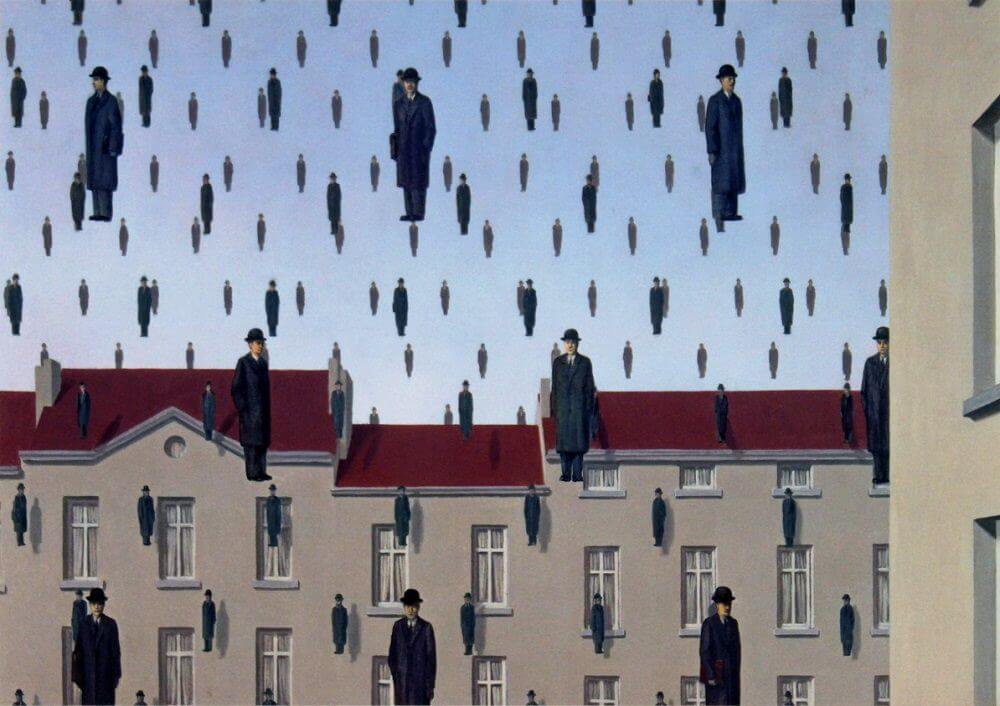
Art by René Magritte
I sit down to write but my mind is saturated with thoughts. I close my eyes to go to a place of quiet. A few seconds pass by and I soon notice a barrage of thoughts, quite random and unrelated to each other, flow through my mind. Which music track should I listen to? I should go out for a walk. I should watch Harry Potter Part II tonight. What’s a good horror movie to watch? What’s my todo list for tomorrow? What should I eat for dinner?… the list goes on.
I take some deep breaths and bring my awareness to the present moment. The flow of thoughts begins to slow down, but doesn’t come to a complete halt. They are still random, having no logical correlation, but, at this moment, I have an epiphany: there is a second group or category of thoughts that exists or coexists in my mind. This group of thoughts is quite distinct in nature and character from the thoughts I have been talking about. This category of thoughts are the ones that constitute this blog post.
Contrary to the random thoughts I observed earlier, these thoughts have an almost perfect structure, logical flow and rhythm to them. They a strong direction. Here, I pause for a moment and reflect: what are these two seemingly opposite and contradictory sides to thought? One is random while the other is organized and structured. While I reflect on this puzzling nature of thoughts and continue writing this article, it’s as if by some sort of magic these thoughts arrange themselves in a logical order and produce the next set or subset of thoughts, thus giving a strong flow and direction to my blog post.
So, what gives thought direction? I think there is only one logical and rational answer to my question — it is my mind or intellect , the apparatus or device that has the power to analyze, improve and structure thoughts — that gives my thought the content and direction that makes it uniquely mine. My mind superimposes itself onto my thoughts and brings about, what I shall call, a conscious awareness to them.
But what’s happening in my mind when random thoughts are flowing in it? Where do they come from? Why are they random? Why is there no direction to them? I sit still for a moment, moving my pen in my hand, trying to conjure up an answer from the sea of unconscious thought.
It is when I try to seek an answer that my mind supplies it. How does this happen? How did the answer come to me? I don’t have a definite answer to this, and I’m not well read in psychology or psychiatry so I can’t use medical or scientific language — the only answer that makes sense to me is that in the moment I act and consciously try to conjure up an answer, I exercise my will and my will gives my thought the content and direction. I call this part of my thought conscious thought. By exercising my will or bringing my awareness to the present, I awaken my mind that was otherwise asleep or unconscious.
It is so, then, when my mind is awake, it gives content and direction to my thought on what to write and where to go with it. Each moment in time is intrinsically connected to the next so the flow of logical rhythm doesn’t break. When my mind is in this flow-state, I write down thoughts that give structure to this blog post and help me finish it. On the other hand, when my mind drifts off into the oblivion of the subconscious or unconscious thought, I find myself doodling on the paper or scribbling random thoughts.
I come to a conclusion then, that there are two parts of mind — the unconscious mind and the conscious mind. I also come to a second conclusion that it is the exercise of my will that wakes up the unconscious mind and gives direction and rhythm to my thoughts.
At this point, I ponder on an insight: does my mind give content and direction to my thoughts that already exist in it, or does it also have the power to generate new thoughts? Do I, by the very act of conscious thinking, generate new thoughts that are unique to me? If so, what is this mind that I speak of? Is it some sort of a container that contains the vast sea of unconscious thought, its origin unknown? Or, is it also a kind of a generator or a device that forms and communicates new, conscious thought?
This will be the subject of inquiry of a later blog post. I conclude this blog post on the insight that there is a dual nature to thought — the random and the structured thought, and these both kinds of thoughts either exist or coexist in our minds. How the two are connected is a fascinating question that takes us into the realm of the unconscious mind.
Leave a Reply