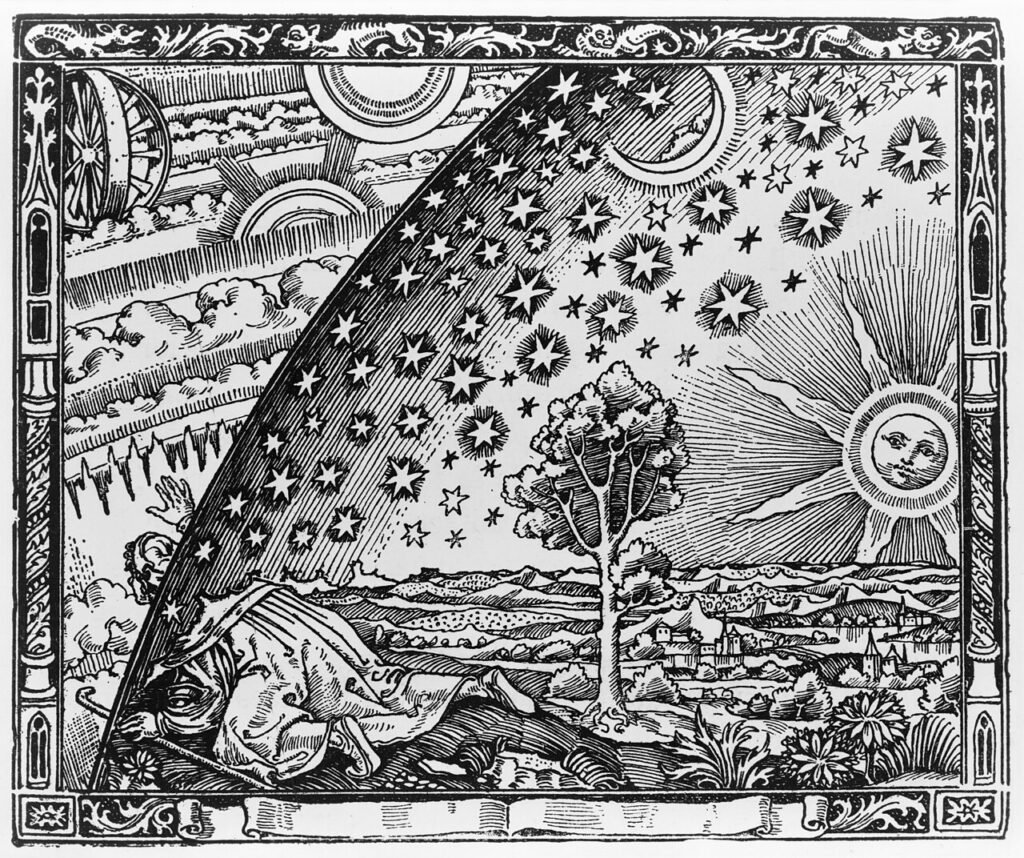
Art: Flammarion engraving — unknown artist, 1888
Imagine a man born inside a room.
The room has four walls, one door, and one window.
The door is locked.
The window is not.
Through it, the man can see a tree, a narrow road, a fragment of sky, and, on particularly clear days, the faint outline of a hill in the distance.
He grows up studying this view.
He notices how the tree changes with the seasons. He learns the rhythm of the road. He recognizes the birds that return every year. He observes the changing colour of the sky. He knows which direction the shadows fall in the morning and how they retreat in the afternoon.
Over time, his knowledge becomes remarkably detailed.
He writes about the tree.
He writes about the road.
He studies the movement of clouds.
Eventually, he begins writing about the world.
And perhaps, from his perspective, there is nothing unreasonable about this.
Everything he has ever seen lies beyond that window.
Everything he knows about existence has come through that opening in the wall.
Then, one day, the door opens.
For the first time, he steps outside.
He discovers that the tree he studied for decades stands beside thousands of other trees. The road continues far beyond anything he could see from the window. The hill in the distance is only the beginning of a mountain range.
Beyond the mountains are cities.
Beyond the cities, oceans.
Beyond the oceans, continents.
And somewhere inside that enormous world stands a small room with a single window.
Was the man wrong about what he saw?
Not necessarily.
The tree existed.
The road existed.
The sky existed.
His observations may have been extraordinarily accurate.
His mistake was not that he failed to understand the things within his view.
His mistake was believing that his view represented the whole.
Which raises an uncomfortable question.
How often do we do the same?
the position of the observer
Human beings have spent thousands of years trying to understand existence.
We have developed philosophy, mathematics, theology, physics, astronomy, biology, psychology.
We have built telescopes capable of seeing galaxies whose light began travelling toward us billions of years ago.
We have split atoms.
We have mapped the human genome.
We have sent machines beyond the planets.
And yet, for all of this, we remain observers positioned in one particular place.
We experience existence through one species.
One type of brain.
One biological body.
One tiny planet.
One brief interval in cosmic history.
Our senses give us access to a portion of what surrounds us.
Our minds attempt to interpret that portion.
Then we build our understanding of reality from what arrives.
There is nothing inherently wrong with this. How else could knowledge work?
But perhaps there is a danger hidden inside the process.
What if the greatest limitation on knowledge is not intelligence?
What if it is perspective?
An intelligent observer standing in the wrong place may reason brilliantly and still misunderstand the larger picture.
A person inside a maze can understand every turn immediately around him and still have no idea what the maze looks like from above.
Perhaps knowledge is not only a question of how deeply we look.
Perhaps it is also a question of where we are looking from.
And if that is true, how much of what we call reality is simply the portion of reality available from our position?
plato’s cave
More than two thousand years ago, Plato imagined prisoners living inside a cave.
They had been confined there since childhood, facing a wall.
Behind them burned a fire.
Between the fire and the prisoners, objects passed by, casting shadows onto the wall ahead.
The prisoners could not turn around.
The shadows were all they had ever seen.
Naturally, they treated the shadows as reality.
The usual interpretation is that Plato’s cave is a story about ignorance.
But perhaps something more unsettling is happening.
The prisoners are not necessarily stupid.
They observe the shadows.
They notice patterns.
Certain shadows may appear at particular times.
Others might follow predictable sequences.
Given enough generations, the prisoners could develop sophisticated systems for studying them.
They could name the shadows.
Classify them.
Predict them.
They could build philosophies around them.
Perhaps entire intellectual traditions would emerge concerning the nature of shadows.
Arguments might begin.
Schools of thought might form.
One group might insist that a particular shadow represented the fundamental structure of reality.
Another might disagree.
And within the boundaries of the cave, these arguments could become extraordinarily sophisticated.
The problem would not necessarily be their reasoning.
The problem would be their perspective.
They would be attempting to understand a larger reality from a position that revealed only its projection.
This makes Plato’s cave uncomfortable because it leaves us with a question he cannot answer for us.
How do we know we are outside the cave?
We can easily recognize the limitations of people who lived before us.
Ancient civilizations misunderstood the heavens.
Past medical theories now seem primitive.
Political systems once regarded as permanent have vanished.
Philosophical certainties have been revised, overturned, forgotten.
From our position in history, their limitations appear obvious.
But what about ours?
What are the shadows on our wall?
Are they our senses?
Our languages?
Our cultures?
Our assumptions about time?
Our concepts of cause and effect?
Our understanding of consciousness?
Perhaps even the structure of the human mind itself?
If a limitation exists beyond our ability to perceive it, how would we identify it as a limitation?
the mountain
Consider a mountain.
Stand at its base and it appears enormous.
It dominates the landscape.
It towers above you.
Move farther away, and the mountain changes.
From an aircraft, it becomes part of a range.
From orbit, the entire range begins to disappear.
Travel far enough, and the mountain no longer exists as a visible object at all.
Yet nothing happened to the mountain.
The mountain did not shrink.
The observer moved.
That distinction seems simple, but perhaps it tells us something important.
Perspective does not necessarily change reality.
It changes our relationship with reality.
Something similar happens with time.
An argument can consume us today and become almost laughable ten years later.
A failure may feel catastrophic when we are inside it and insignificant when viewed across the span of a life.
A political crisis may appear to define an age, yet centuries later become a paragraph in a history book.
An empire may seem eternal to those living beneath its banners.
To someone looking across millennia, it may appear and disappear almost instantly.
Perspective provides proportion.
Without it, the immediate easily becomes the absolute.
The temporary becomes permanent.
The local becomes universal.
The personal becomes everything.
Perhaps this is one of the reasons human beings so often struggle to judge the importance of events accurately.
We are usually standing too close.
the pale blue dot
In 1990, Voyager 1 turned its camera back toward Earth from billions of kilometers away.
From that distance, our planet appeared as a tiny point of light.
Almost nothing.
A fraction of a pixel suspended in darkness.
Carl Sagan later reflected on the image in what became known as the Pale Blue Dot.
The power of that photograph lies not merely in its scale.
It lies in what the change of perspective does to everything we consider important.
Every empire existed on that speck.
Every war.
Every border.
Every revolution.
Every king.
Every prisoner.
Every fortune.
Every poverty.
Every love affair.
Every murder.
Every poem.
Every prayer.
Every human argument about who owned which piece of land took place on that tiny point.
Seen from the ground, nations appear enormous.
Borders matter profoundly.
Cities feel permanent.
Political conflicts consume generations.
Seen from Voyager, none of those divisions are visible.
Earth is simply Earth.
Again, nothing changed except the observer.
The borders still existed.
The wars still happened.
The suffering was still real.
But their proportion changed.
And perhaps this is why the image carries such philosophical force.
It allows humanity, briefly, to see itself from somewhere else.
What happens when we move far enough away from ourselves?
Which concerns shrink?
Which become more important?
Which certainties lose their grip?
If the difference between the view from the ground and the view from Voyager can be so enormous, what other truths might become obvious from perspectives we are currently unable to occupy?
are we still in the cave?
Human beings have become very good at extending perspective.
The telescope expanded vision.
The microscope revealed worlds invisible to the naked eye.
Mathematics allowed us to describe structures we could never physically observe.
History expanded our perspective across time.
Philosophy attempted to expand it beyond instinct and convention.
Yet every instrument ultimately delivers its information to the same destination.
The human mind.
And perhaps that raises the strangest question of all.
What if some aspects of reality cannot be understood from the human perspective?
Consider an ant crossing the page of a book.
The ant walks across ink.
Its legs touch letters.
It encounters punctuation marks as physical objects.
It may spend its entire life moving across sentences.
And yet the story remains inaccessible.
Shakespeare could lie beneath its feet.
It would never know.
Not because Shakespeare is hidden.
Not because the ant failed to look carefully enough.
The information is present.
The limitation lies in the observer.
Does anything guarantee that human beings occupy a fundamentally different position?
We possess greater intelligence, certainly.
But greater than what?
Greater than an ant?
Greater than a chimpanzee?
Greater than the other organisms we know?
Perhaps.
But compared with every form of intelligence that could possibly exist?
We have no idea.
When we ask questions about consciousness, infinity, death, the origin of existence, or why there is something rather than nothing, perhaps we should occasionally ask another question first.
Are we capable of understanding the answer?
That is not an argument against inquiry.
Quite the opposite.
Perhaps it is an argument for pursuing inquiry with greater humility.
The prisoners in Plato’s cave could not improve their understanding by staring harder at the shadows.
They needed a wider perspective.
perspective as power
If our perspective is inevitably limited, does that make the search for truth hopeless?
I think it makes perspective more valuable.
We may never obtain a complete view of reality.
But we can widen the view we have.
We can step outside the immediate.
We can ask what today’s crisis might look like ten years from now.
We can ask how our convictions might appear to someone born five hundred years in the future.
We can examine our society from outside our culture.
We can examine humanity from outside our nation.
We can examine Earth from outside Earth.
We can look at ourselves through another person’s experience.
We can move backward through history.
We can move outward through space.
Perhaps the power of perspective does not lie in giving us certainty.
Perhaps its power lies in breaking false certainty.
The wider the perspective becomes, the harder it becomes to confuse one window with the entire world.
This may be useful not only in philosophy but in ordinary life.
Many conflicts become possible because perspective narrows.
We become absorbed in our position.
Our grievance.
Our tribe.
Our fear.
Our ambition.
The mind draws a circle around the immediate experience and temporarily labels everything inside it reality.
Sometimes all that is required to change the meaning of an event is distance.
Distance in space.
Distance in time.
Distance from ego.
What appears enormous from one position may become small from another.
And what appears trivial may suddenly become important.
A wider perspective does not tell us that nothing matters.
It may help us understand what matters more.
humility and wonder
There is an easy conclusion to draw from the Pale Blue Dot.
We are small.
The Universe is enormous.
Therefore, nothing matters.
But perhaps that conclusion suffers from the same problem.
It assumes size determines significance.
A human brain is small compared with a planet.
A planet is small compared with a star.
A star is small compared with a galaxy.
And yet somewhere inside this hierarchy of scale, matter became conscious enough to contemplate the hierarchy itself.
That is strange.
A tiny world produced creatures capable of discovering that their world is tiny.
The Pale Blue Dot looked outward and eventually became capable of looking back at itself.
Perhaps cosmic perspective does not diminish human existence.
Perhaps it makes existence more astonishing.
Humility does not require believing that we are meaningless.
It requires recognizing that we are not the centre from which meaning must be measured.
Perhaps wisdom begins when we understand that whatever we know, we know from somewhere.
And somewhere is never everywhere.
the window again
Return to the man in the room.
Years after the door opens, imagine that he climbs one of the mountains he once saw through the window.
From the summit, he looks across the landscape.
Forests stretch beneath him.
Roads intersect.
Rivers disappear into valleys.
Towns lie scattered across the distance.
Then, after searching for some time, he finds the house where he spent the first part of his life.
From this height it looks tiny.
And somewhere on one wall is the window.
The window through which he once studied the world.
The window through which he once believed the world could be understood.
Perhaps he does not laugh at himself.
Perhaps he feels something closer to wonder.
Everything he saw through that window was real.
It simply was not everything.
And perhaps that is the position we all occupy.
We look outward through the windows available to us.
We observe.
We reason.
We learn.
We build extraordinary systems of knowledge.
But somewhere beyond the edge of every perspective may lie another landscape.
Another mountain.
Another way of seeing.
Perhaps the danger is not that our perspective is limited.
Every perspective must be.
The danger begins when we forget the existence of the frame.
How different might the world become if, every once in a while, we remembered to step away from the window?
Leave a Reply