
Art: The Man Contemplating the Moon by Caspar David Friedrich, 1825-30.
Two People, No Words
Imagine two people sitting at a table.
Between them, a cup of tea has gone cold. Evening gathers at the window. Somewhere beyond the room, a car passes, then another. Neither person speaks.
What would you say about them?
Perhaps they have quarreled. Perhaps one has asked a question the other cannot answer. Perhaps they have spent forty years together and feel no need to explain the evening.
Or perhaps they have just met.
The scene offers us a table, two people, and an absence of words. Yet almost at once, we begin supplying a story. We imagine affection. We suspect distance. We hear something in a conversation that has not taken place.
How can nothing being said mean so many different things?
We often think of language as something that announces itself. A voice reaches us. A sentence takes shape. Someone finds the words, and we try to understand them.
But much of our lives pass in the spaces around those words. We wait before answering. We fall quiet after hearing something. We sit beside someone and discover that speaking would either help the moment or spoil it.
Could silence, too, be a language?
I would like to think so. Though if it is, it has a curious vocabulary. The same silence can seem tender to one person and unbearable to another.
And sometimes, even the person keeping it does not know what it means.
Before the First Word
Where does a thought begin?
Before we can say that we miss someone, there may be an impulse to turn towards an empty chair, an empty room, an empty house. Before we can explain why a place feels like home, we may already have relaxed into its familiar sounds.
Something has happened within us. The sentence arrives later.
It is tempting to imagine silence as the place from which all thought emerges: a stillness before the first movement, a waiting before the first word. If language has a beginning within us, perhaps this is where we should look.
Yet the idea becomes less simple as we approach it.
A thought can interrupt a crowded train journey. An argument can produce an understanding that a quiet afternoon never did. And a mind without words may still be busy with images, sensations, and half-formed fears.
Does the absence of language amount to silence?
Perhaps we need to distinguish the quiet around us from whatever exists before we have found an expression for it. The two can meet, but they need not arrive together.
Consider a feeling you have carried for days without being able to name it. Then, in conversation, a word appears. Disappointment. Envy. Relief.
You recognize yourself in it.
Did the word merely describe what was already there? Or did it give the feeling a shape it had not possessed before?
We may never catch the exact instant when an impression becomes a thought. By the time we examine it, we are often already using words.
Still, there is something worth attending to in that earlier uncertainty. We do not always know what we think before we begin to listen inwardly. We do not always know what we feel before we allow the feeling to remain unnamed for a while.
Perhaps silence is one of the places where meaning can wait until we are ready to meet it.
When the World Falls Quiet
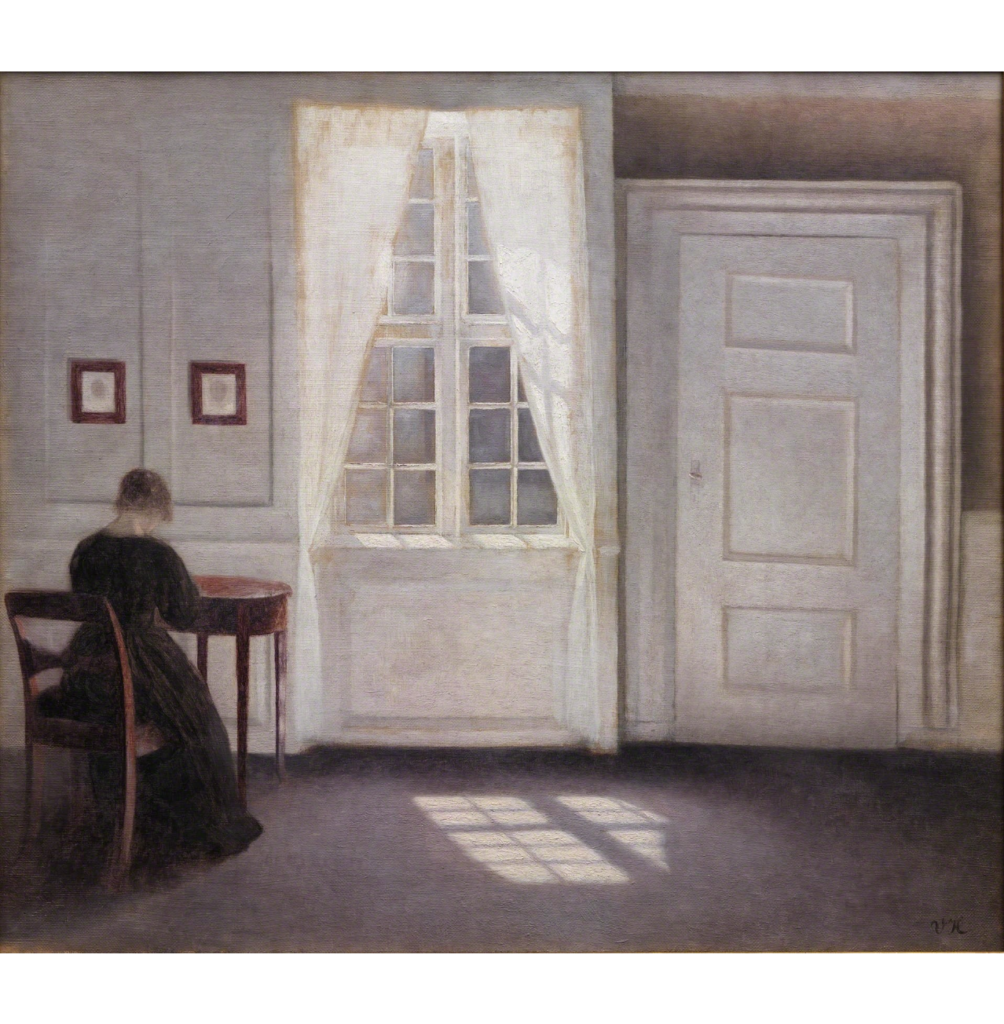
Art: Inteior in Strandgade, Sunlight on the Floor by Vilhelm Hammershøi, 1901.
The conversation ends. The music stops. We place the phone face down.
For a moment, there is relief.
Then something we had managed not to think about returns.
It might be a small thing: a remark from the morning, a task postponed, the memory of someone’s expression when we left. Or it might be the question we have spent years keeping occupied enough to avoid.
Am I happy with the life I am making?
Noise can give us company. It can also give us somewhere to hide. There is always another message to read, another opinion to consider, another person’s life to enter for a few minutes. Our own can wait.
In silence, the waiting sometimes ends.
We notice the wish beneath the sensible explanation. We admit that we are tired. We discover that something we claimed not to want still matters to us.
This is one reason silence can bring us closer to ourselves. It gives neglected feelings a chance to be heard.
But should we trust everything that speaks when the world falls quiet?
An old criticism may return in a voice so familiar that we mistake it for our own. A passing fear may present itself as a final judgment. Alone at night, we can become very certain of things that look different in the morning.
The loudest thought is not necessarily the truest.
Perhaps knowing ourselves requires more than turning down the world. It requires learning how to attend to what remains. To ask where a belief came from. To notice whether a desire persists, or appears only when we compare ourselves with someone else.
Silence gives us the opportunity for this attention. It does not perform the work for us.
We may enter it hoping to find a clear, settled self. We may instead find several wishes, some contradictory, all asking to be considered.
Could that discovery also be a kind of honesty?
The Noise Inside Silence
Think of the quiet after an argument.
The room is still, but the conversation continues within you. You prepare a better answer. You repeat the sentence that hurt. You imagine what you should have said, and hear it delivered with a confidence that arrived too late.
Now think of sitting beside someone who has fallen asleep.
You hear their breathing. The small creak of a chair seems suddenly loud. You reach for a cup carefully, unwilling to disturb anything.
Both moments contain little speech. Yet how different it feels to inhabit them.
There is no uniformity in silence.
It can be peaceful. It can be crowded with noise. It can hold bliss, dread, boredom, or a confusion for which we have no useful name. The same room can feel restful on one evening and oppressive on the next, without a single object having moved.
What has changed is the person sitting in it.
Even that is not the whole explanation. Circumstance matters. So does choice. An hour alone that we have longed for is different from an hour alone because nobody came.
We cannot understand a silence merely by measuring how little sound it contains.
Imagine waiting for a reply to a message. At first, the silence seems ordinary. The other person is busy. Later, you check again. Still nothing. Gradually, an empty screen begins to acquire intention.
Have I upset them? Are they avoiding me? Did I say too much?
Nothing new has appeared on the screen. A great deal has appeared within you.
When silence becomes unbearable, what exactly are we hearing?
Sometimes it is a real uncertainty that deserves an answer. Sometimes it is an old fear finding a new occasion. Often, we cannot easily separate the two.
This may be why advice to simply enjoy the quiet can feel so inadequate. Quiet is not the same experience for everyone. It may not even be the same experience for the same person twice.
Before asking what silence offers us, we might ask what we have brought into it.
What We Say Without Speaking
There is another difficulty. Silence is something we experience, but it is also something we do.
Someone asks a question. We leave it unanswered.
Someone begins to cry. We stop trying to fill the room.
Someone says something cruel. Nobody objects.
In each case, the absence of speech enters the situation and changes it. It may offer room, create uncertainty, or leave a person feeling painfully alone.
Yet the act and its meaning are not always easy to connect.
A person may remain silent because they agree. They may also be frightened, exhausted, confused, or unable to find a way into the conversation. To assume that every silence is agreement would be to erase all these possibilities.
Can silence say anything clearly on its own?
Much depends on what surrounds it. The expression on a face. A hand withdrawn or extended. What happened yesterday. What has happened many times before.
If someone who usually listens patiently falls quiet, we may feel invited to continue. If someone has often punished us by refusing to speak, the same pause may make us anxious.
History enters the room before the next word does.
Perhaps silence borrows much of its meaning from this history. We learn to read it as we learn to read a familiar face, through repeated encounters rather than a fixed set of rules.
Still, familiarity can make us careless. We decide that we know what another person means. We stop leaving room for surprise.
And we may be equally careless with our own silence. We intend it as patience while someone else experiences it as indifference. We withhold a thought because we fear causing hurt, unaware that the withholding has already begun to hurt.
If silence is a language, intention alone cannot make it understood.
What we mean to offer and what another person receives can be very different things.
A Silence That Is Full
And yet there are moments when silence seems to need no translation.
Two people sit outside as the light fades. One moves a chair slightly closer. Neither remarks on it. Somewhere nearby, dinner is being prepared; the air carries the smell of food, and the day’s heat is slowly leaving the stone beneath their feet.
There is nothing urgent to explain.
They could speak. They simply feel no pressure to do so.
Such silence can feel full. The moment already contains enough: the familiar presence, the shared view, the ease of being allowed to exist without making ourselves interesting.
How much effort do we ordinarily spend proving that we are good company?
We tell a story. We offer an opinion. We search for something amusing before the pause grows awkward. With certain people, that effort falls away. We can be tired. We can have an unfinished thought. We can watch the evening arrive at its own pace.
There is a particular tenderness in this freedom.
A different fullness may exist beside someone who is grieving. We sit with them and find that the sentences we rehearsed on the way no longer seem useful. Perhaps we place a glass of water within reach. Perhaps we stay.
The silence cannot remove the loss. But our presence may mean that, for this hour, they do not have to bear it alone.
Then there are silences full of everything that cannot yet be said.
An apology waits behind pride. A question threatens an answer we are not ready to hear. Years of small disappointments gather around the simple inquiry, “Are you all right?”
There is no shortage of words. There is no easy place to begin.
From outside, these silences may resemble one another. Two people sit together. Neither speaks.
Inside one silence, words are unnecessary. Inside another, words are desperately needed.
When we say there is nothing to say, which of these do we mean?
The Risk of Misunderstanding
Perhaps the greatest risk is believing that a shared silence must be a shared experience.
One person feels trusted. The other feels forgotten.
One is allowing space. The other is waiting to be asked to stay.
They occupy the same room, but they may be living through entirely different moments.
This does not make silent understanding an illusion. It makes it something we should hold with care. Even people who know each other well remain partly unknown to one another. Love does not remove the need to ask.
Nor does it give us perfect access to another person’s mind.
We can be so moved by the idea of wordless understanding that we begin to demand it. If they really knew me, we think, they would know why I am quiet. If I have to explain, the explanation somehow counts for less.
But why should the need for words diminish the feeling behind them?
There is tenderness in being understood without speaking. There is also tenderness in someone taking the trouble to explain, and in our taking the trouble to listen.
A simple question can change the quality of a silence.
Would you like some company?
Do you need time?
Have I misunderstood?
The answer may itself take a while. Asking does not entitle us to an immediate confession. But it can leave an opening where there was only an assumption.
We might ask the same courtesy of ourselves. Before deciding what someone else’s silence means, we can notice the story we have already begun telling about it.
What have they actually shown us? What are we remembering? What are we afraid of?
How much of what we hear in another person’s silence have we supplied ourselves?
Listening to What Remains
Return to the two people at the table.
The tea is still cold. Evening has almost left the window. Neither has spoken.
We have more possibilities now. We might be looking at peace, estrangement, grief, or a thought still searching for its first sentence. We might be looking at a moment that means something different to each person in it.
What we do not have is certainty.
Perhaps that is a useful place to end an inquiry into silence. It asks something of us that words also ask, though we often forget it: patience with meaning before we decide that we have understood.
Within ourselves, this might mean allowing a feeling to appear without immediately naming it a weakness, a revelation, or the truth about our lives. Between ourselves and others, it might mean staying attentive enough to notice when quiet offers comfort and when a question would be kinder.
We need not make silence sacred to take it seriously. Some silences nourish us. Some need to be broken. Others need time before we can tell.
Is silence a language, then?
I still find myself drawn to the possibility. It can carry something from one person to another. It can allow something within us to become perceptible. Yet its meaning remains inseparable from the lives passing through it.
At the table, one person reaches for the other’s hand.
We know a little more now. Still not everything.
When nothing is being said, how carefully are we listening?
Leave a Reply